Understanding the total investment for high-performance sports surfaces is critical for facility managers and developers. When analyzing football turf cost, it is essential to look beyond the initial purchase price and consider the long-term value provided by material quality, drainage efficiency, and durability. A well-planned budget ensures that the playing surface meets professional standards while remaining economically sustainable.
Globally, the shift toward synthetic solutions is driven by the need for all-weather accessibility and reduced maintenance overhead. The fluctuation in football turf cost is often influenced by the composition of the yarn—such as the blend of PP and PE—and the sophistication of the backing system. For those seeking a balance between aesthetics and performance, choosing a product with a proven track record of non-toxicity and longevity is paramount.
Ultimately, the goal is to maximize the utility of the space without compromising on safety or quality. By evaluating the football turf cost against specifications like pile height, dtex, and water permeability, stakeholders can make an informed decision that guarantees a professional-grade experience for athletes and a high return on investment for owners.

Global Industry Context of Football Turf Cost
The global demand for artificial sports surfaces has surged as urban centers prioritize multi-functional recreational spaces. In this context, football turf cost is no longer just a line item but a strategic investment in public health and sports infrastructure. Following ISO standards for material safety, the industry has pivoted toward non-toxic, lead-free compositions to ensure athlete safety.
From professional stadiums to community hubs, the economic impact of choosing a high-density turf is evident in the reduction of water consumption and mowing labor. By analyzing the football turf cost through the lens of lifecycle analysis, it becomes clear that premium materials with a 5-year warranty significantly lower the total cost of ownership compared to cheaper, short-lived alternatives.
Defining the Components of Football Turf Cost
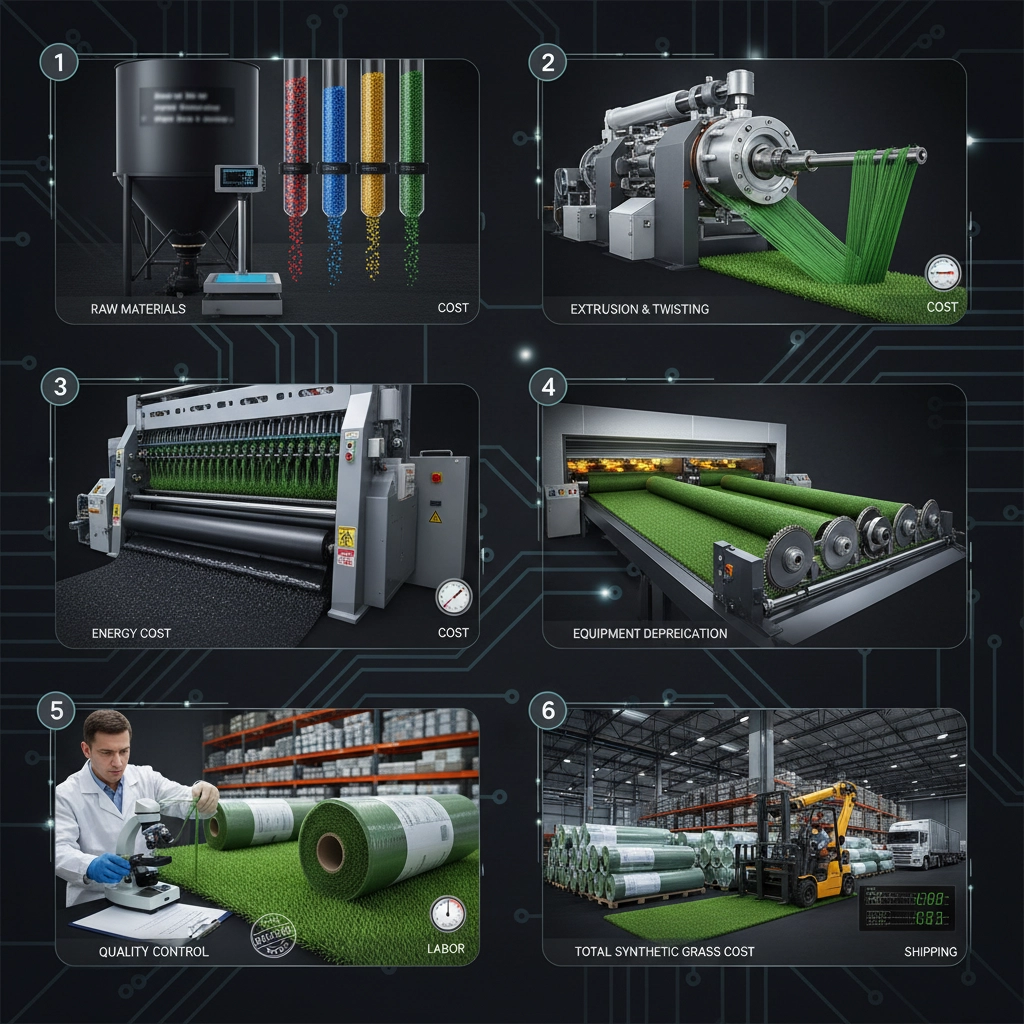
When we discuss football turf cost, we are referring to the sum of raw material expenditures, manufacturing precision, and installation requirements. The primary cost driver is the yarn composition; for instance, a blend of PP (Polypropylene) and PE (Polyethylene) provides the necessary resilience and softness required for high-impact sports, balancing durability with a natural feel.
Another critical component is the density and stitch rate. A density of 15,750 stitches/m² ensures that the pile remains upright under heavy traffic, which prevents the "matting" effect common in low-grade products. This technical specification directly impacts the football turf cost because higher stitch counts require more precision during the tufting process.
Finally, the backing system—such as a PP composite and mesh with a weight of 120 g/m²—adds structural integrity. The inclusion of specialized drainage holes every 10cm ensures that water permeability remains high (60L/min/m²), preventing standing water and extending the lifespan of the field, which ultimately justifies a higher initial football turf cost.
Key Factors Influencing Surface Value
The perceived football turf cost is heavily influenced by the pile characteristics. A pile height of 20mm with a total carpet height of 23mm is engineered to mimic the physics of natural grass, providing the right amount of shock absorption for players' joints while maintaining ball roll speed.
Durability is a cornerstone of value. With a Tuft Lock of ≥40N and a Pile Dtex of 8500, the turf resists pulling and wear. When customers evaluate football turf cost, these parameters represent the "insurance" against premature degradation and the need for costly replacements.
Aesthetics also play a role in the commercial value of a project. The use of multi-tonal greens—such as field green combined with apple or olive tones—alongside brown thatch creates a lifelike appearance. This visual fidelity increases the prestige of the facility, adding intangible value that outweighs the marginal increase in football turf cost.
Global Applications and Cost Efficiency
In diverse climates, from the humid tropics to arid regions, the football turf cost is offset by the elimination of irrigation. In remote industrial zones or urban centers where water is scarce, synthetic turf becomes a humanitarian and environmental necessity, allowing sports to thrive without depleting local water tables.
Commercial landscaping firms often integrate these surfaces into large residential complexes to provide low-maintenance green zones. By calculating the football turf cost per square meter across rolls of 2m or 4m width, developers can optimize their layout to minimize waste and maximize coverage.
Comparative Analysis of Football Turf Cost Efficiency
Long-Term Value and Sustainability
The sustainability of synthetic turf is found in its ability to withstand intense usage without soil erosion. When analyzing football turf cost, one must factor in the 5-year warranty and the use of non-toxic materials. This ensures that the facility does not become an environmental liability, protecting both the players and the surrounding ecosystem.
Furthermore, the drainage rate of at least 30 inches per hour is a critical value-add. By preventing standing water, the turf reduces the risk of mold and bacterial growth, which would otherwise increase maintenance costs. Thus, a slightly higher upfront football turf cost translates into a safer, cleaner, and more reliable playing environment.
Future Trends in Synthetic Turf Innovation
The future of football turf cost will be shaped by the integration of recycled polymers and smarter manufacturing processes. We are seeing a trend toward "biomimetic" yarns that not only look like natural grass but react to impact and friction in a way that further reduces athlete injury rates.
Digital transformation in the manufacturing phase is also optimizing the stitch rate and density distributions. By reducing material waste during the production of 25m rolls, manufacturers can offer more competitive pricing without sacrificing the technical specs that justify the football turf cost.
Additionally, there is a growing movement toward "cool-turf" technology to combat the urban heat island effect. While this may initially increase the football turf cost, the energy savings from reduced surrounding cooling needs and improved player comfort make it a viable long-term strategy.
Challenges and Technical Solutions
One of the primary challenges in managing football turf cost is the balance between pile density and permeability. Too much density can impede water flow, while too little can lead to rapid wear. The solution lies in the precision gauge of 3/8 inch and a systematic drainage hole layout every 10cm.
Another hurdle is the environmental concern regarding microplastics. Industry leaders are addressing this by utilizing high-stability PP+PE blends and reinforced Tuft Locks (≥40N) to prevent yarn shedding. This technical rigor ensures that the football turf cost includes the cost of environmental compliance and safety.
Lastly, installation errors can often inflate the total project cost. By providing standardized rolls of 2m/4m and clear technical specifications on water permeability (60L/min/m²), manufacturers enable contractors to install the turf efficiently, ensuring that the actual football turf cost remains within the projected budget.
Technical Specification Analysis for Football Turf Cost Optimization
| Technical Parameter | Standard Specification | Impact on Cost | Performance Value |
|---|
| Yarn Composition | PP + PE | Moderate | High Resilience |
| Stitch Density | 15750 stitches/m2 | High | Wear Resistance |
| Drainage Rate | 60L/min/m2 | Moderate | All-Weather Use |
| Tuft Lock | ≥40N | Low | Yarn Retention |
| Pile Height | 20mm | Moderate | Player Comfort |
| Backing Material | PP Composite/Mesh | Moderate | Structural Stability |
FAQS
The most significant factors include the yarn material (PP vs PE), the stitch density (e.g., 15,750 stitches/m²), and the quality of the backing system. Higher densities and advanced drainage designs increase the initial cost but lower long-term maintenance and replacement expenses.
High-efficiency drainage (such as 60L/min/m²) requires precision-cut drainage holes and high-quality geotextile fabrics. While this adds to the manufacturing cost, it prevents water pooling, which protects the sub-base and extends the turf's lifespan, providing better value.
Yes, for professional-grade turf, a 5-year warranty is a key indicator of quality. It ensures that the manufacturer stands by the non-toxic materials and the tuft lock strength (≥40N), mitigating the financial risk of early degradation for the buyer.
Reducing pile height may lower the raw material cost, but it can compromise player safety and the "natural" feel of the field. A 20mm pile is generally recommended as the optimal balance between cost-efficiency and performance.
Dtex refers to the linear density of the yarn. A higher Dtex (like 8500) means a thicker, stronger yarn. This increases the material cost but ensures the turf can withstand heavy athletic use without flattening, reducing the frequency of replacements.
Using certified non-toxic and lead-free materials may involve a slight premium in production costs. However, this is essential for health compliance and athlete safety, making it a non-negotiable part of the value proposition for any modern sports facility.
Conclusion
In summary, evaluating football turf cost requires a comprehensive look at technical specifications, including stitch density, drainage capacity, and material safety. By prioritizing high-performance attributes such as a 15,750 stitches/m² density and a 60L/min/m² water permeability rate, facility owners can ensure a durable, safe, and aesthetically pleasing environment that serves athletes for years to come.
Looking forward, the industry will continue to innovate with sustainable materials and enhanced ergonomics, further optimizing the ratio between initial investment and long-term utility. We recommend that stakeholders focus on certified lead-free products with robust warranties to guarantee the highest return on their investment. For more professional solutions, visit our website: www.xy-grass.com.