When evaluating the overall astroturf lawn cost, it is essential to look beyond the initial purchase price and consider the total cost of ownership. For professional sports facilities, the investment in high-grade synthetic turf is not merely an expense but a strategic decision to ensure athlete safety and operational efficiency. By analyzing the balance between installation costs and long-term maintenance savings, stakeholders can make informed choices that maximize their facility's utility.
Across the global sports industry, the shift toward professional-grade artificial surfaces like the FG50 is driven by the need for consistency and durability. While the upfront astroturf lawn cost may be higher than natural grass seeding, the elimination of daily watering, mowing, and chemical fertilization creates a sustainable financial model. This is particularly critical in regions with extreme weather where maintaining a natural pitch is nearly impossible.
Understanding the nuances of astroturf lawn cost allows facility managers to allocate budgets effectively, prioritizing materials that meet international standards such as FIFA certifications. By investing in high-density polyethylene (HDPE) and advanced shock-absorbing layers, organizations reduce the hidden costs associated with athlete injuries and frequent surface repairs, ensuring a high return on investment over the product's lifespan.

Global Industry Context of Astroturf Lawn Cost
The global demand for athletic surfaces has evolved rapidly, with the astroturf lawn cost becoming a central point of discussion for municipal governments and private sports clubs. In accordance with international quality benchmarks, the industry has seen a move toward HDPE and PP composite materials that offer superior resilience. This shift is largely driven by the need to reduce the environmental footprint of water-intensive natural grass, especially in arid regions.
Moreover, the integration of FIFA-standard specifications into the manufacturing process has standardized how we calculate astroturf lawn cost. By focusing on parameters such as pile density (10,500 stitches/m2) and drainage rates (60L/min/m2), the industry now provides a transparent cost-to-performance ratio, allowing developers to predict the longevity and maintenance requirements of their investment accurately.
Defining the Value of Astroturf Lawn Cost
In simple terms, astroturf lawn cost refers to the comprehensive financial outlay required to acquire, install, and maintain a high-performance synthetic grass system. Unlike basic decorative turf, professional football grass like the FG50 incorporates a multi-layer composite structure, including a high-strength mesh base and an eco-friendly shock-absorbing cushion, which justifies a higher initial price point through enhanced durability.
From an industry perspective, this cost is deeply connected to the humanitarian need for accessible sports infrastructure. By providing a durable, all-weather surface, communities can ensure that sports facilities remain open year-round, promoting public health and athletic development regardless of the local climate or soil quality. The "cost" is therefore transformed into a social investment in community wellness.
Ultimately, the true meaning of astroturf lawn cost is found in the "cost per use." When a field can accommodate ten times the hourly traffic of a natural grass pitch without deteriorating, the effective cost drops significantly, making professional synthetic turf the most economical choice for high-traffic training centers and stadiums.
Core Components Influencing Astroturf Lawn Cost
One of the primary drivers of astroturf lawn cost is the material composition. The use of high-density polyethylene (HDPE) and polypropylene (PP) composites ensures that the fibers resist abrasion and matting. The specialized S-Shape pile and a dtex of 7500 provide the necessary structural integrity to mimic natural grass, which requires a more complex and costly extrusion process than standard plastics.
Another critical factor is the shock-absorption technology. The integrated elastic cushion layer, designed to protect athletes' joints and bones, adds to the initial astroturf lawn cost but drastically reduces the long-term medical risks and liabilities associated with high-impact sports. This layer ensures that the surface remains safe even during high-intensity sprints and slides.
Finally, certification and compliance—such as meeting FIFA Quality and Quality Pro standards—influence the final astroturf lawn cost. Rigorous testing for UV resistance, color stability, and water immersion ensures the product lasts for years without fading or degrading, providing a guaranteed 8-year warranty that protects the buyer's investment against premature failure.
Global Applications and Cost Efficiency
Professional synthetic turf is applied globally, from elite stadiums in Europe to community sports complexes in Southeast Asia. In these diverse environments, the astroturf lawn cost is justified by the ability to maintain a 100% uniform surface. For instance, in professional training centers, the rapid drainage rate of 60L/min/m2 ensures that fields are usable immediately after heavy rainfall, maximizing the usable playing hours and revenue potential.
In remote industrial zones or areas with poor soil quality, the installation of FG50 turf bypasses the need for expensive soil remediation and irrigation systems. By analyzing the astroturf lawn cost against the cost of importing water and fertilizer to remote regions, synthetic solutions emerge as the only viable way to provide professional-grade athletic facilities.
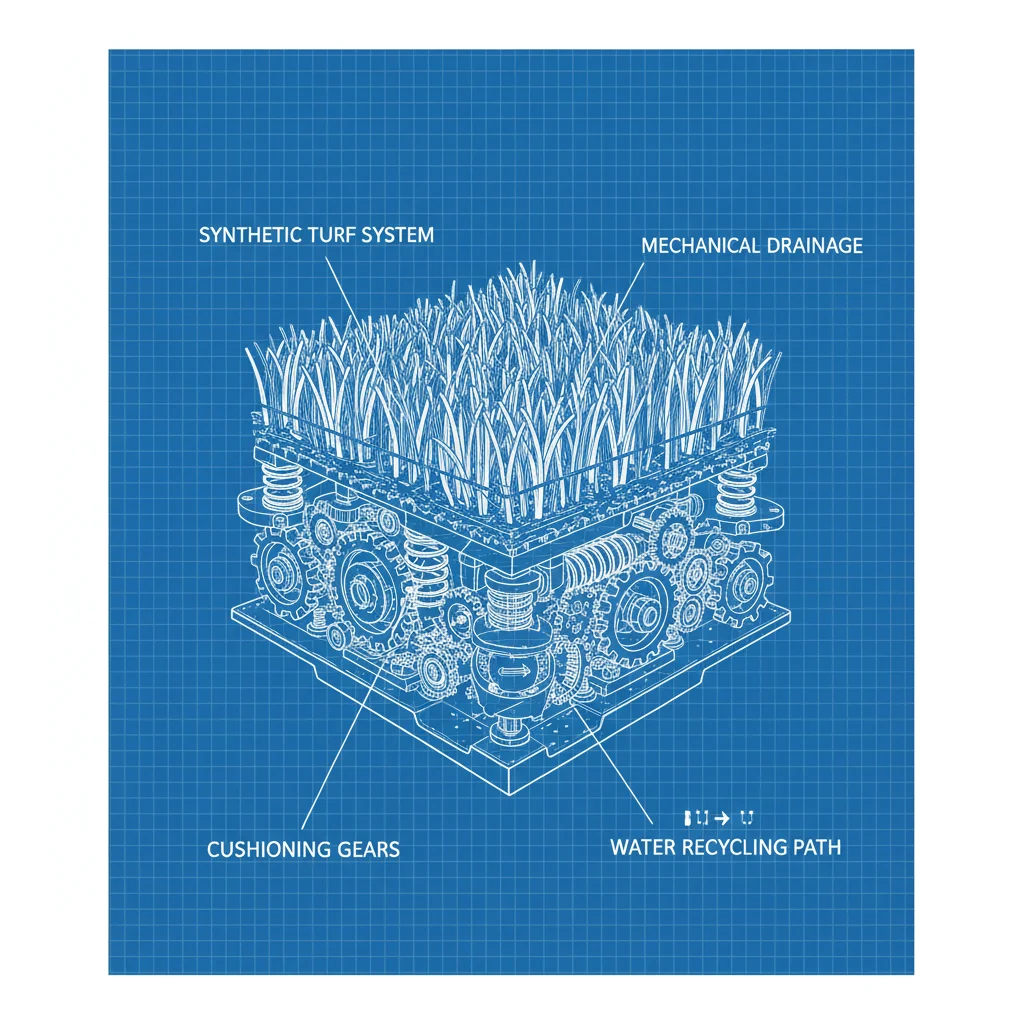
Comparison of Synthetic Turf Investment Values
Long-Term Value and Athlete Protection
The long-term value of investing in a high-quality astroturf lawn cost is most evident in athlete protection. The FG50's integrated elastic cushion layer disperses impact forces, which is a critical feature for preventing joint injuries. When compared to the inconsistent surfaces of natural grass, which can develop dangerous potholes or slippery patches, the uniformity of synthetic turf provides a level of safety and trust that is priceless for professional athletes.
Furthermore, the economic logic extends to the lifespan of the product. With a comprehensive 8-year warranty from XYGrass, the astroturf lawn cost is amortized over nearly a decade of heavy use. This reliability eliminates the need for seasonal re-seeding and the constant cost of water and chemicals, making it a sustainable choice for both the budget and the environment.
Future Trends in Synthetic Turf Costing
The future of astroturf lawn cost is being shaped by the transition toward circular economies and green energy. New advancements in polymer recycling mean that high-performance HDPE can be produced with a lower carbon footprint without sacrificing the 50mm pile height or the 200 stitches/m rate. This digital transformation in manufacturing allows for more precise extrusion, reducing waste and potentially lowering the cost of premium turf.
Additionally, the integration of "smart" drainage systems and antimicrobial fibers is expected to become standard. While these innovations may initially increase the astroturf lawn cost, they will further reduce maintenance overhead by preventing mold growth and improving water runoff efficiency in extreme climates.
We are also seeing a trend toward modular installation, where roll sizes (such as the standard 2m or 4m widths) are optimized for rapid deployment. This automation in installation reduces labor costs, ensuring that the final delivered astroturf lawn cost is more competitive, enabling more community centers to afford FIFA-grade surfaces.
Challenges and Solutions in Budgeting
One of the most common challenges in budgeting for astroturf lawn cost is the temptation to choose lower-grade materials to save on initial costs. However, this often leads to "matting"—where fibers flatten under pressure—resulting in a hard surface that increases injury risk and requires premature replacement. The solution is to prioritize "Anti-Matting Technology," as seen in the FG50, which uses scientifically calibrated fiber density to maintain resilience.
Another challenge is the misconception regarding the maintenance of synthetic turf. Some believe it is "zero maintenance," which can lead to neglect. In reality, a low astroturf lawn cost for maintenance involves periodic brushing to keep the S-shape pile upright. By incorporating a simple brushing schedule into the operational budget, facility managers can extend the life of the turf well beyond the 8-year warranty.
Finally, navigating the complexities of international shipping and customs can inflate the perceived astroturf lawn cost. Partnering with experienced manufacturers like XYGrass, who provide standardized roll sizes and comprehensive after-sales support, simplifies the logistics chain and ensures that the project stays within the allocated budget.
Comparison of Long-Term Investment: Natural vs. FG50 Synthetic Turf
| Feature/Metric | Natural Grass Cost | FG50 Synthetic Cost | Economic Impact |
|---|
| Initial Installation | Moderate | High (Upfront) | Higher initial outlay for FG50 |
| Monthly Maintenance | High (Water/Mow) | Low (Brushing) | Significant operational savings |
| Usage Capacity | Low (Recovery needed) | Very High | More revenue per square meter |
| Weather Downtime | High (Muddy/Frozen) | Negligible | Consistent year-round access |
| Lifespan Guarantee | Seasonal Care Req. | 8-Year Warranty | Predictable long-term budget |
| Surface Consistency | Variable/Patchy | 100% Uniform | Reduced athlete injury costs |
FAQS
While the initial astroturf lawn cost for FG50 is higher due to professional-grade HDPE/PP composite materials and the integrated shock-absorbing cushion, the long-term costs are significantly lower. You eliminate expenses for watering, mowing, fertilizing, and re-seeding. Over an 8-year period, the synthetic option is typically more cost-effective due to its durability and high usage capacity.
Yes. For community pitches, the value lies in the reduced injury risk and all-weather accessibility. The FG50 meets FIFA standards, ensuring consistent ball roll and joint protection. This prevents the high "hidden cost" of athlete injuries and ensures the pitch remains a community asset 365 days a year, regardless of weather conditions.
The most significant cost drivers are the pile density (10,500 stitches/m2), the quality of the HDPE filaments, and the addition of a high-strength mesh base with a shock-absorbing layer. Additionally, professional installation to ensure a drainage rate of 60L/min/m2 requires precision groundwork, which is a critical part of the total investment.
XYGrass provides a comprehensive 8-year warranty for the FG50. When you divide the total astroturf lawn cost by the 8-year lifespan, the annual expense is quite low. Because it is engineered with UV stabilizers and anti-matting technology, it retains its performance and color, avoiding the need for expensive mid-life replacements.
While different pile heights exist, the 50mm pile height of the FG50 is optimized for professional football to balance resilience and softness. Choosing a significantly lower quality or shorter pile might reduce the initial cost, but it often increases the risk of abrasion and reduces the shock-absorption capabilities, potentially increasing costs through higher maintenance and athlete injuries.
The high-permeability base allows for a drainage rate of 60L/min/m2. This minimizes field downtime after rain or snow. In a commercial setting, this means more usable playing hours and more booking opportunities, which directly offsets the initial astroturf lawn cost by increasing the facility's revenue-generating potential.
Conclusion
In summary, analyzing the astroturf lawn cost requires a comprehensive view that balances initial capital expenditure with long-term operational savings. The FG50 Football Grass, with its FIFA-grade HDPE/PP composite construction, 50mm pile height, and advanced shock-absorption, proves that investing in quality materials leads to superior athlete protection, unmatched durability, and significantly lower maintenance requirements compared to natural turf.
Looking forward, the adoption of professional synthetic surfaces will continue to grow as sustainability and efficiency become the primary drivers of sports infrastructure. For facility managers and developers, the recommendation is clear: prioritize certified, high-density turf to ensure a safe, consistent, and economically viable playing environment for years to come. Visit our website for more professional solutions: www.xy-grass.com