In the current landscape of commercial landscaping and high-end residential design, the selection of synthetic turf is increasingly driven by a balance between aesthetic realism and long-term durability. For procurement managers and architects, understanding the artificial grass 40mm price is not merely about finding the lowest cost per square meter, but about analyzing the value proposition of pile height relative to traffic load and maintenance requirements.
The industry is shifting away from generic "green carpets" toward engineered turf systems that mimic biological grass structures. This evolution introduces a complex set of variables, including pile density, yarn composition, and drainage efficiency, all of which directly impact the final market price. For those specifying 40mm heights, the primary technical challenge lies in ensuring the turf maintains its verticality under pressure while remaining permeable enough to avoid standing water.
This analysis explores the cost-benefit framework of medium-to-high pile artificial grass, examining how material specifications influence longevity and overall project ROI. By breaking down the technical components of professional-grade turf, we provide a roadmap for making informed procurement decisions based on actual engineering data rather than marketing claims.


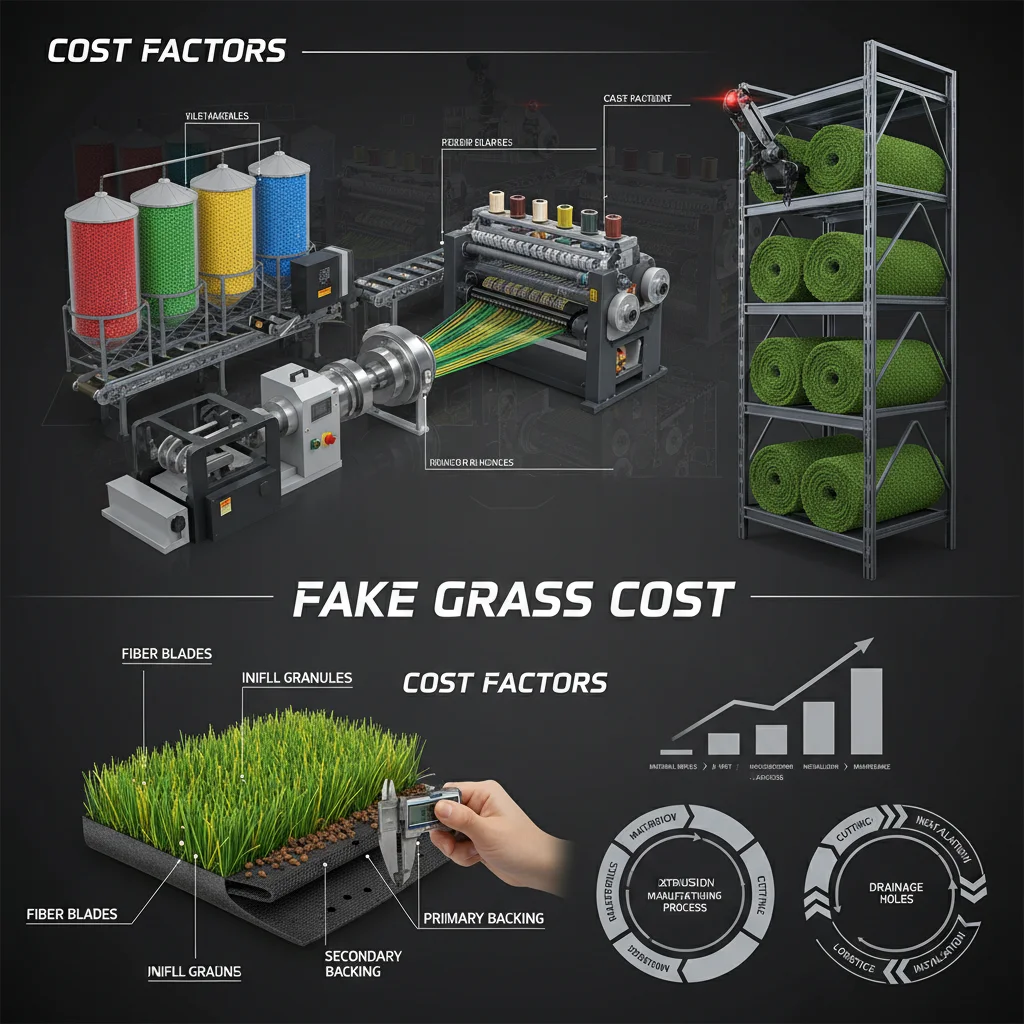
Pile height is one of the most significant determinants of the raw material cost in synthetic turf manufacturing. Increasing the height to 40mm requires more polymer per square meter, but the true cost driver is the "stiffness-to-height" ratio. To prevent a 40mm blade from flattening prematurely, manufacturers must increase the Dtex (linear density) of the yarn or modify the shape to a more resilient profile.
From a manufacturing perspective, this involves a precise balance of PP (Polypropylene) and PE (Polyethylene) compositions. While cheaper options use lower-grade polymers, professional systems integrate UV-stabilized yarns that resist degradation, ensuring the investment in a higher pile height translates into years of aesthetic stability rather than rapid collapse.
When evaluating the technical data of a product like the Garden Grass series, the relationship between pile height (e.g., 30mm to 33mm total) and stitch rate is critical. A higher stitch rate (such as 150 stitches/m) increases the density, which provides a more luxurious feel and better support for the blades. This density directly influences the cost, as it requires more machine time and more yarn consumption per unit area.
Furthermore, the backing system—such as a latex-backed drainage design—adds another layer of value. A drainage rate of at least 30 inches per hour is essential for large-scale residential or commercial applications to prevent anaerobic conditions in the sub-base. Investing in a high-permeability geotextile fabric (typically PP composites) reduces the long-term risk of mold and turf failure, lowering the total cost of ownership.
Material safety, specifically the use of non-toxic, lead-free materials and compliance with REACH and ROHS standards, is no longer optional. While these certifications may slightly increase the initial production cost, they are mandatory for projects involving children or pets, as they mitigate legal risks and ensure environmental safety.
The decision between a 30mm and 40mm pile often involves a trade-off between "lushness" and "resilience." Higher piles provide a more natural, deep-grass look, which is highly desirable for decorative landscaping. However, in high-traffic areas, a very high pile without sufficient density can lead to "matting," where the grass stays flat after being stepped on.
Another critical factor is the color composition. Professional turf uses a multi-tonal approach—combining field green, apple green, and olive green with a brown thatch layer. This visual complexity mimics real grass and masks the gaps between blades, allowing for a slightly lower density without sacrificing the realistic appearance, which can optimize the overall project budget.
Different applications demand different performance profiles, which in turn affect the ideal pile height and budget. For a decorative garden, the aesthetic value of a 40mm pile is paramount. In contrast, a playground or a sports field requires a shorter, denser pile that can withstand extreme abrasion and high-frequency impact without losing its shape.
By analyzing the "Value Score" (a combination of durability, aesthetics, and installation cost), procurement officers can determine if the premium for a higher pile is justified. The following assessment compares different turf configurations based on their operational efficiency in specific environments.
In a typical commercial deployment, such as a hotel rooftop or a corporate courtyard, the priority is a combination of visual impact and low maintenance. Here, a high-density 30-40mm turf with an integrated drainage layer is essential. The installation process involves a crushed stone sub-base to ensure the 60L/min/m2 water permeability of the turf is fully utilized, preventing surface pooling during heavy rain events.
For residential gardens, the focus shifts toward safety and comfort. The use of non-toxic polymers and a soft-touch yarn profile ensures that the area is safe for pets and children. In these scenarios, the "artificial grass 40mm price" is often viewed as an investment in property value, as it eliminates the ongoing costs of irrigation, mowing, and chemical fertilization associated with natural lawns.
The synthetic turf industry is moving toward "circular economy" models, with an increasing focus on recyclable polymers. Current R&D is targeting the development of mono-material turf systems where the yarn and the backing are made from the same polymer family, making the entire product fully recyclable at the end of its lifecycle.
Additionally, we are seeing the integration of "smart" fibers that can reflect more infrared radiation to reduce the surface temperature of the grass in hot climates. This "cooling effect" is becoming a critical requirement for playground installations in regions like the Middle East and Southern North America, where surface heat can exceed safe limits for children.
Lastly, the move toward automated weaving and coating processes is reducing production waste and improving the consistency of the stitch rate. This industrial automation allows manufacturers to offer high-specification products, such as those with a 40mm pile, at more competitive price points without compromising the technical integrity of the product.
Choosing the right turf requires a systematic comparison of technical profiles. Buyers should not look for a "best" product, but rather the "best fit" for their specific operational load. A high-duty configuration might be overkill for a residential balcony but essential for a commercial walkway.
When reviewing quotes, it is vital to verify the Tuft Lock strength (e.g., ≥40N) and the water permeability. A low-cost 40mm turf that lacks a proper drainage hole gauge (e.g., 10cm) will likely fail within two years due to sub-base saturation and turf displacement.
The following matrix provides a framework for evaluating different configuration profiles based on standard industry benchmarks.
| Configuration Profile | Pile Specification | Durability Rating | Recommended Use Case |
|---|---|---|---|
| Basic Profile | 20-30mm Low Density | Standard | Low-traffic Balconies |
| Standard Profile | 30-33mm Medium Density | High | Residential Gardens |
| Premium Profile | 35-40mm High Density | Very High | Commercial Landscapes |
| High-Duty Profile | Short Pile / Ultra Density | Extreme | Sports / Playgrounds |
| Specialty Profile | Variable/Colorful | Medium | Exhibition / Events |
| Industry Baseline | 30mm / Standard Dtex | Moderate | General Purpose |
Pile height directly impacts the volume of polymer required per square meter. A 40mm pile requires more raw material than a 20mm pile. However, the price increase is also tied to the necessary increase in yarn Dtex and density to ensure the longer blades don't flatten. Therefore, the cost is a function of both material volume and the structural engineering required to maintain the pile's verticality under traffic.
The 'M' shape is an engineering design that provides superior resilience compared to flat or C-shaped yarns. Because the yarn has a built-in structural bend, it acts like a spring. In a 40mm pile, this is critical because longer blades are more prone to matting; the M-shape ensures the grass recovers its position after being compressed, extending the aesthetic lifespan of the installation.
Evaluate drainage based on two metrics: the permeability of the geotextile backing (e.g., 60L/min/m2) and the overall system drainage rate (e.g., 30 inches per hour). Ensure the product has a designated drainage hole gauge (such as 10cm) to prevent water from pooling. In commercial projects, this must be matched with a permeable sub-base to avoid turf saturation and subsequent failure.
A 5-year warranty is common for professional-grade products, covering UV degradation and manufacturing defects. However, buyers should check if the warranty includes "pile collapse" or only "yarn breakage." A comprehensive warranty typically reflects the manufacturer's confidence in the UV stabilizers and the structural integrity of the yarn Dtex relative to the pile height.
The primary risks are rapid matting due to low density and poor UV resistance leading to color fading. Low-cost options often use lower-grade PP/PE blends without adequate UV inhibitors. Additionally, poor backing quality can lead to "delamination," where the grass blades detach from the backing, regardless of the pile height, resulting in a complete loss of the investment.
Choose 40mm if the primary goal is a lush, high-end aesthetic and the area has low-to-medium foot traffic. Choose 30mm if the area will be used for frequent activities, pets, or as a high-traffic walkway. The 30mm option generally offers better resilience and a more stable surface for movement, while the 40mm provides a superior visual experience.
The analysis of the artificial grass 40mm price reveals that cost is a secondary metric to structural integrity. The true value of professional synthetic turf lies in the synergy between pile height, yarn shape (such as the M-profile), and drainage efficiency. When these elements are aligned, the resulting system provides a sustainable, low-maintenance alternative to natural grass that enhances both aesthetic and functional property value.
For procurement professionals, the practical implication is clear: avoid pricing based on height alone. Instead, prioritize Dtex, stitch rate, and certified non-toxic materials to ensure long-term performance. By utilizing a technical evaluation matrix, stakeholders can align their budget with the actual operational demands of the environment, ensuring a high ROI and a durable, lifelike landscape.



Hit enter to search or ESC to close