Finding a balance between budget and quality is the primary challenge for property managers and homeowners searching for cheap artificial turf for sale. While the allure of a low initial price point is strong, the long-term viability of synthetic grass depends heavily on technical specifications that are often overlooked in entry-level listings.
The shift toward synthetic landscaping is driven by a desire to eliminate the high costs of irrigation and chemical fertilizers. However, the market is saturated with varying grades of polymers, meaning "cheap" can either mean "efficiently manufactured" or "low-durability." Understanding the intersection of material science and cost allows buyers to secure a high-value investment rather than a temporary fix.
This analysis explores the critical technical indicators that separate sustainable budget options from poor-quality alternatives, providing a framework for selecting turf that maintains its aesthetic and functional integrity over time.


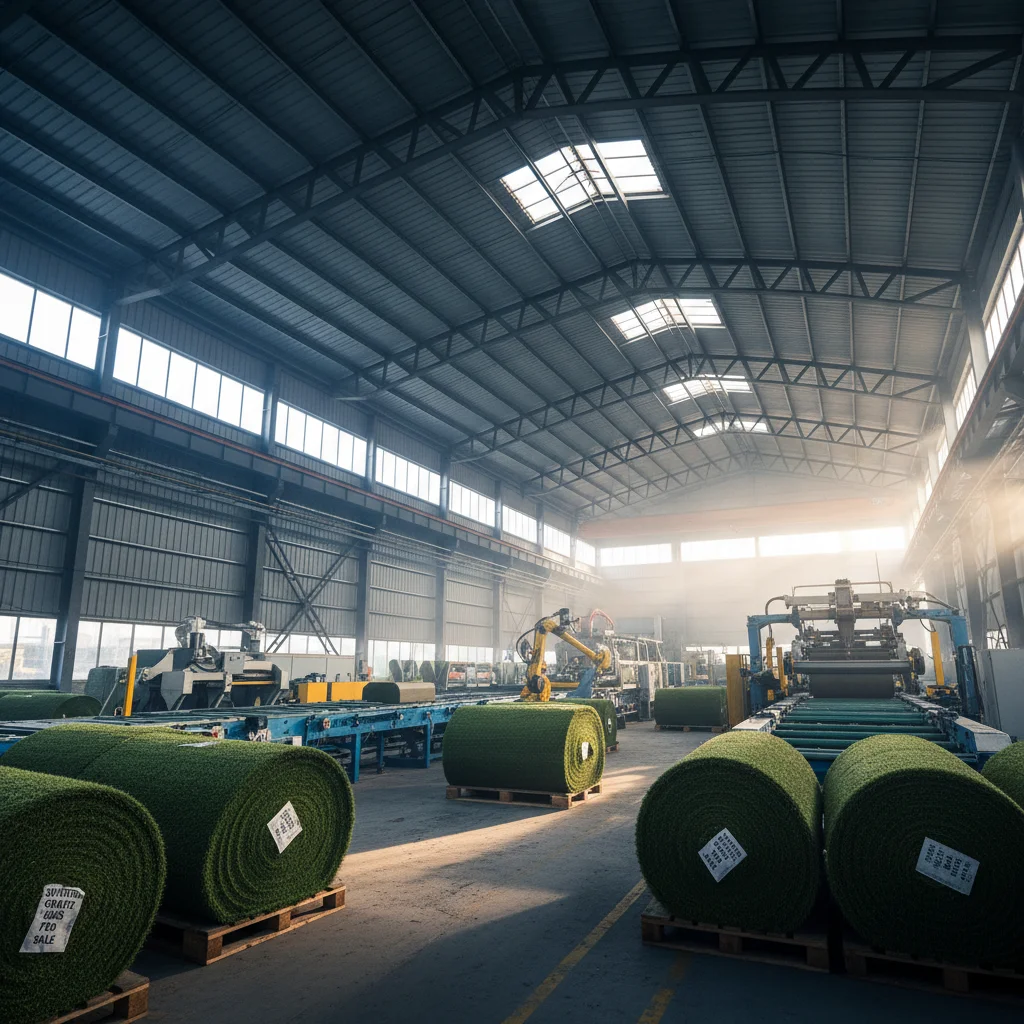
The search for affordable synthetic grass often leads buyers into a complex web of terminology. In the manufacturing sector, "cheap" is a relative term. Value is generated through integrated production—where extruding, weaving, and coating occur under one roof—eliminating the margins typically taken by middlemen.
When analyzing options for cheap artificial turf for sale, the focus should shift from the price per square meter to the total cost of ownership. This includes the longevity of the UV stabilizers and the efficiency of the drainage backing, which prevent premature replacement.
The structural integrity of budget-friendly turf is determined by the yarn composition and the stitch density. High-value options typically utilize a blend of Polypropylene (PP) and Polyethylene (PE). PE provides the soft, natural feel and UV resistance, while PP offers the structural rigidity needed for the base. A density of around 15,750 stitches/m² ensures that the turf looks lush without requiring an excessive amount of expensive raw material.
Another critical factor is the yarn shape. Standard C-shaped yarns tend to flatten quickly. In contrast, the M-shaped yarn found in professional-grade budget series, such as the Garden Grass (GG30), provides a mechanical spring-back effect. This geometry allows the blades to recover their upright position after being compressed, significantly extending the product's aesthetic lifespan in high-traffic residential areas.
Finally, the backing system is the unsung hero of turf performance. A latex-backed system with a mesh reinforcement (such as 120g/m²) ensures that the turf does not stretch or warp over time. For budget seekers, a drainage rate of 30+ inches per hour is the benchmark; anything less often leads to standing water, mold growth, and a shorter product lifecycle.
Evaluating the return on investment for synthetic grass requires comparing the immediate installation cost against the perpetual expenses of natural lawn care. While natural grass requires constant irrigation, mowing, and pesticide application, synthetic options operate on a "set and forget" logic, provided the initial technical specifications are correct.
True value in artificial turf is not found in the lowest sticker price, but in the convergence of non-toxic material safety, UV stability, and high-speed water permeability that eliminates long-term maintenance overhead.
For example, selecting a turf with a 5-year warranty indicates a manufacturer's confidence in the polymer's UV resistance. When a product uses a four-color green blend (field green, apple green, olive green) combined with brown thatch, it achieves a realistic look that prevents the "plastic" appearance common in ultra-low-end products, thereby increasing the property's perceived value.
Resilience in synthetic turf is measured by its ability to withstand environmental stress and physical compression. Key metrics include the Tuft Lock strength (measured in Newtons) and the Dtex (yarn linear density). A Tuft Lock of ≥40N ensures that the fibers remain securely attached to the backing even under intense activity, preventing the "bald spots" often seen in inferior budget turf.
When assessing cheap artificial turf for sale, comparing the Dtex value—such as the 8500 Dtex used in the GG30 series—reveals the thickness and durability of the individual fibers. Higher Dtex generally correlates with better wear resistance and a more substantial feel underfoot.
Budget-friendly synthetic grass is not a one-size-fits-all solution. In a typical residential garden, a pile height of 30mm to 33mm provides the ideal balance between a lush appearance and ease of maintenance. These areas benefit from the M-shape resilience, allowing the turf to withstand pet activity and children's play without permanent deformation.
For commercial applications, such as office perimeter landscaping or retail storefronts, the focus shifts toward water permeability. A rate of 60L/min/m² is essential in urban environments to prevent drainage system overload during heavy rain, ensuring that the artificial landscape remains an asset rather than a liability.
The industry is moving toward a "safety-first" manufacturing paradigm. Historically, low-cost synthetic fibers often contained lead or harmful phthalates to reduce production costs. Modern standards, including REACH and ROHS compliance, have forced a shift toward non-toxic, lead-free materials that are safe for pets and children.
Innovations in UV stabilization have also reduced the tendency of budget turf to fade. By incorporating UV absorbers directly into the PE/PP blend during extrusion, manufacturers can ensure that the multi-tonal greens remain vibrant for years, even in high-exposure climates.
Furthermore, the integration of specialized latex backings has replaced older, less permeable glues. This evolution allows for higher water flow rates, which naturally inhibits the growth of algae and mold, thereby reducing the need for chemical cleaning agents.
When evaluating cheap artificial turf for sale, buyers should employ a technical checklist rather than relying on marketing adjectives. The goal is to identify the "sweet spot" where the price is low, but the critical specs—drainage, non-toxicity, and yarn resilience—are non-negotiable.
Trade-offs are inevitable in budget selections. For instance, one might sacrifice an ultra-high pile height (e.g., 50mm) for a more durable, denser 30mm pile. This is often a wise decision, as shorter, denser piles are generally more resilient to flattening and easier to clean.
The following framework provides a relative assessment of different turf categories to guide the decision-making process based on specific usage requirements.
| Application | Priority Metric | Recommended Spec | Suitability Index |
|---|---|---|---|
| Low-Traffic Garden | Aesthetics | Multi-tonal/30mm+ | High |
| Pet Areas | Drainage/Safety | Non-toxic/Latex Back | Essential |
| Children's Play | Resilience | M-Shape Yarn/High Density | High |
| Commercial Edge | Durability | PP+PE Blend/UV Stabilized | Moderate |
| Balcony/Terrace | Thickness | Low Pile/High Permeability | High |
| Sport/Active Use | Tuft Lock | ≥40N / Industrial Grade | Critical |
"Cheap" turf often refers to products with low stitch density, C-shaped yarns that flatten quickly, and toxic additives to lower costs. "Value" turf, such as the GG30 series, maintains a low price point through integrated manufacturing but retains critical technical specs like M-shaped yarn, non-toxic lead-free materials, and professional drainage systems. The difference is found in the total cost of ownership; value turf lasts years longer, reducing the need for replacement.
Look for certifications and explicit manufacturer guarantees regarding non-toxic and lead-free materials. Ensure the product complies with international safety standards like REACH and ROHS. Additionally, check the drainage specifications; a high permeability rate (e.g., 60L/min/m²) is crucial for pet areas to prevent the buildup of ammonia and bacteria, ensuring a hygienic environment for animals and children.
Fading depends on the quality of UV stabilizers used in the PE and PP yarn. High-value budget turf integrates these stabilizers during the extrusion process. If a product uses a blend of four different green tones and a brown thatch, it not only looks more natural but also masks minor weathering better than single-tone turf. A 5-year warranty is usually a strong indicator that the product is treated for long-term UV stability.
Yes, 30mm to 33mm is widely considered the "gold standard" for residential gardens. It provides enough depth to feel lush and natural without being so long that it becomes difficult to clean or prone to flattening. When paired with M-shaped yarn, this height offers excellent resilience, ensuring the grass bounces back after foot traffic while maintaining an evergreen appearance year-round.
The most critical spec is the permeability rate of the backing. A professional latex-backed drainage system should allow water to permeate at a rate of at least 30 inches per hour (or roughly 60L/min/m²). This prevents the formation of puddles and inhibits mold growth in the sub-base. Always verify the backing material; a combination of latex and a reinforced mesh is superior to basic glued backings.
Maintenance is minimal but necessary. Use a leaf blower or vacuum to remove organic debris (leaves, twigs) to prevent them from decomposing into the fibers. For the pile, occasional brushing with a soft-bristled brush helps maintain the M-shape upright position. Rinsing with water is sufficient for most cleaning needs, as the non-toxic materials used in quality budget turf do not require harsh chemical treatments.
Securing high-quality cheap artificial turf for sale is a matter of technical scrutiny rather than luck. By prioritizing M-shaped yarn resilience, non-toxic material safety, and high-speed drainage, buyers can achieve a professional landscape without the premium price tag.
Ultimately, the goal of synthetic turf is to provide a sustainable, evergreen environment with minimal effort. When the technical foundations—such as the PP+PE blend and latex backing—are sound, a budget-friendly option can outperform expensive alternatives in both practicality and long-term value.


Hit enter to search or ESC to close