When budgeting for a new outdoor recreational space, the variance in synthetic turf price often creates a significant decision-making hurdle for facility managers and homeowners. The gap between entry-level synthetic grass and high-performance engineered turf is not merely a matter of brand, but a reflection of material density, backing technology, and long-term environmental resilience.
The market has shifted from seeing artificial grass as a simple cosmetic replacement to viewing it as a strategic infrastructure investment. Factors such as drainage efficiency and UV stabilization now dictate the true cost of ownership, as cheaper alternatives often lead to premature fading and structural failure within a few seasons.
Understanding the technical drivers behind these costs allows buyers to move beyond the sticker price and evaluate the total return on investment. This analysis explores the critical parameters that influence pricing and how specific engineering choices impact the longevity of high-traffic installation areas.


Historically, artificial grass was judged primarily on its visual resemblance to natural lawns. However, the industry has evolved toward "performance-based" value. Modern buyers now prioritize the molecular stability of the polymers and the structural integrity of the backing over simple aesthetics.
This transition is driven by the increased use of synthetic turf in high-traffic commercial zones and public playgrounds. In these environments, the cost of replacement far outweighs the initial savings of a budget-grade product, shifting the focus toward durability indices and warranty-backed performance.
Several engineering variables directly impact the synthetic turf price. One of the most significant is the Dtex—the weight of the yarn. A higher Dtex, such as 7500, indicates a thicker, more robust blade that can withstand more crushing force before flattening. When combined with a high stitch rate (e.g., 150 stitches/m) and a high overall density, the result is a plush, resilient surface that maintains its verticality under heavy foot traffic.
Yarn shape also plays a role in both cost and feel. C-shape or M-shape yarns are designed to provide better "spring-back" capabilities than flat blades, reducing the need for frequent brushing. The chemical composition, typically a blend of Polypropylene (PP) and Polyethylene (PE), balances the stiffness required for structure with the softness needed for safety in playground or garden environments.
Finally, the inclusion of integrated UV inhibitors during the extrusion process—rather than as a surface coating—increases manufacturing complexity but ensures that the evergreen appearance is permanent. This prevents the "seasonal browning" effect seen in lower-quality products and significantly extends the usable lifespan of the installation.
The visible blades are only half of the story; the backing system is where the most critical structural engineering occurs. Standard latex backings are prone to cracking over time, whereas polyurethane (PU)-coated backings provide superior seam strength and resistance to ripping. This is particularly vital in playgrounds where children's activities create multi-directional tension on the turf.
A perforated, non-absorbent backing layer is the industry benchmark for high-performance drainage, enabling water permeability rates up to 60L/min/m2 to prevent pooling and bacterial growth.
For a company like Hebei Xiongyi Rubber & Plastic Products Co., Ltd., the integration of these drainage systems into their PG Series ensures that commercial projects remain operational even after heavy rainfall. By eliminating the water-holding capacity of the backing, the turf reduces the risk of odors and mold, which is a primary concern for pet-friendly zones and residential gardens.
Evaluating the cost of synthetic turf requires a comparison between the one-time installation investment and the continuous expenses associated with natural grass. Natural lawns incur monthly costs for water, fertilizers, and professional mowing. In contrast, high-grade synthetic options move these costs to the front end of the project.
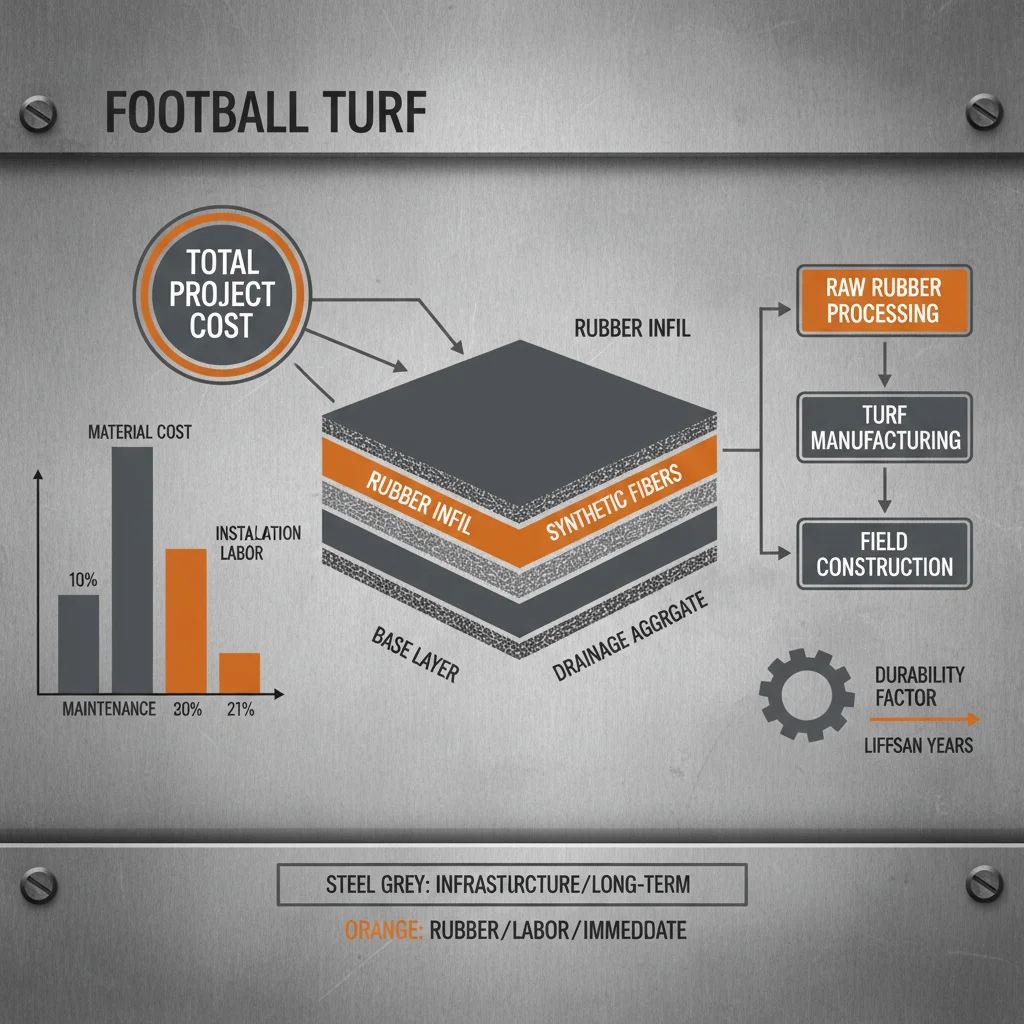
When analyzed over a five-year period, the ROI becomes clear. The elimination of water bills and labor costs often offsets the initial price premium of a high-density product. The following index illustrates the relative cost-benefit distribution across common landscaping factors.
In a typical commercial playground setting, the priority is a balance between impact absorption and extreme durability. A product with a 20mm pile height and a high stitch density (15750 stitches/m2) provides the necessary cushion for children while resisting the flattening that occurs in high-traffic "runways." For these scenarios, a 4-color green blend is often selected to maintain a natural aesthetic that doesn't feel clinical.
Conversely, residential pet zones require a higher emphasis on the drainage system. The ability to pass 60L/min/m2 of liquid prevents the accumulation of waste-related moisture in the sub-base, which is critical for hygiene. In these cases, the polyurethane-coated backing is non-negotiable, as it prevents pet claws from pulling the turf fibers loose over time.
The industry is moving toward more sustainable polymer chains that maintain high UV resistance without sacrificing softness. The integration of advanced UV inhibitors directly into the raw PP and PE yarns allows for a thinner blade thickness (around 100μm) that remains strong, reducing the overall weight of the roll without compromising its lifespan.
Precision machinery, such as 3/8 inch gauge equipment, is becoming standard for high-end manufacturing. This precision ensures a uniform stitch rate, which eliminates "bald spots" in the turf and creates a more consistent surface for sports and play. This level of quality control is what distinguishes professional-grade turf from consumer-grade products.
Furthermore, the move toward standardized 2m and 4m width rolls with precision cutting reduces installation waste. This not only lowers the total project cost but also ensures seamless joins, which are the most common points of failure in poorly installed synthetic lawns.
Selecting the right turf requires weighing immediate costs against specific site requirements. A low-traffic decorative area can utilize a thinner pile and standard backing, but a public space demands the structural reinforcements found in the PG Series. The trade-off is usually between the initial synthetic turf price and the frequency of maintenance.
Buyers should use a multi-factor evaluation model that considers the Dtex, the backing material, and the warranty period. A 5-year warranty is a strong indicator of manufacturer confidence in the UV stability and seam strength of the product.
The following table provides a relative suitability framework for different synthetic turf specifications based on typical application demands.
| Technical Factor | Low Traffic / Deco | Residential Pet | Commercial Play |
|---|---|---|---|
| Pile Density | Moderate | High | Extreme |
| Backing Type | Latex/Standard | PU Coated | PU Coated |
| Drainage Req. | Basic | High (Perforated) | High (Perforated) |
| Yarn Dtex | Low-Mid | Mid-High | High (7500+) |
| UV Resistance | Standard | Integrated | Integrated |
| Warranty Focus | Appearance | Hygiene/Wear | Structural/Traffic |
Pricing is primarily driven by material density (stitch rate and Dtex), the quality of the backing (PU vs. Latex), and the integration of UV inhibitors. Higher-end turf uses more raw polymer per square meter and more complex manufacturing processes to ensure the blades remain upright and the color remains vibrant under intense sunlight, whereas budget options use thinner yarns and simpler coatings.
Polyurethane (PU) provides significantly stronger adhesion between the turf fibers and the backing layer. This prevents "tufting," where blades are pulled out by pets or heavy foot traffic. It also creates much stronger seams during installation, ensuring that the turf doesn't shift or gap over time, which is a common failure point in lower-cost installations.
Yes, especially for pet owners and those in rainy climates. A high drainage rate ensures that water passes through the turf into the sub-base quickly, preventing puddles and the stagnant moisture that can lead to odors and mold. A perforated, non-absorbent backing is essential for maintaining a hygienic environment in residential gardens.
Coatings are applied to the surface of the blade and wear off over time due to friction and weathering. Integrated inhibitors are mixed into the polymer resin before the yarn is extruded, meaning the UV protection is present throughout the entire thickness of every blade. This ensures the grass remains evergreen regardless of the season or sunlight intensity.
Higher pile heights generally offer more cushioning and a more natural look. However, for high-traffic areas, the focus should be on the density (stitches per m2) and the yarn shape. A 20mm pile with high density, like the PG Series, provides an ideal balance of softness for safety and resilience to prevent the turf from flattening in high-use zones.
The ROI is realized through the elimination of recurring costs: no water bills, no mowing labor, and no fertilizer expenses. While the initial investment is higher, the extended lifespan (often backed by a 5-year warranty) and zero maintenance mean that premium turf typically becomes more cost-effective than natural grass or budget synthetic options within 2 to 3 years.
Navigating the synthetic turf price landscape requires a shift in perspective from "cost per square meter" to "value per year of service." By prioritizing technical specifications like PU-coated backings and integrated UV stabilization, buyers can ensure their installation remains functional and aesthetic for years to come.
Ultimately, the choice of material should be dictated by the specific demands of the environment. Whether it is a high-traffic commercial playground or a private pet-friendly garden, investing in engineered performance today prevents the costly cycle of premature replacement and maintenance in the future.



Hit enter to search or ESC to close