

Colored Turf Football Fields: The Definitive B2B Procurement & Performance Guide
As an import manager, brand owner, or sourcing agent exploring colored turf football fields, your core questions likely revolve around long-term durability, player safety, colorfastness, and finding a supplier capable of delivering consistent quality at scale. This guide provides a data-driven analysis of modern synthetic turf systems, moving beyond marketing claims to focus on technical specifications, compliance, and the procurement realities of sourcing from a specialized factory. We will examine how advanced manufacturing and OEM/ODM capabilities directly address the primary pain points in today's market.
Industry Pain Points in Sourcing Colored Football Turf
Procurement decisions for colored synthetic turf are complex, often hindered by several critical challenges that impact both project viability and long-term ROI.
- Color Fading and Inconsistency: Intense UV exposure can cause rapid fading, leading to an unattractive, patchy field appearance within a short period. Inconsistent dye lots from the manufacturer result in visible seams and color mismatches.
- Durability & Performance Anxiety: Concerns over fiber wear, infill migration, and loss of playability (ball roll, traction, shock absorption) after heavy use are paramount. A field that degrades quickly represents a significant financial loss.
- Safety and Compliance Uncertainty: Navigating the landscape of safety certifications (ASTM, EN, FIFA) and material compliance (heavy metals, PFAS) is essential. Non-compliant products risk liability and failed project approvals.
- Supply Chain & Logistical Hurdles: Unreliable lead times, poor communication, and hidden costs in logistics can derail project timelines. The need for large, consistent quantities (often multiple containers) demands a supplier with robust export experience.
- Limited Customization & Support: Many suppliers offer only catalog items, lacking the technical support for custom colors, logos, or performance specifications tailored to specific leagues, brands, or institutions.
Technical Solutions: The Anatomy of a High-Performance Colored Turf System
A superior colored turf football field is an engineered system. Each component must be specified to address the pain points above.
Fiber Technology: The Key to Color and Wear Resistance
The grass fiber (yarn) is the most visible component. For colored fields, the technology focuses on UV stabilization and physical resilience.
| Feature | Technology & Benefit | Common Specification |
|---|---|---|
| UV Stabilizers | Premium polymers (e.g., Polyethylene) are compounded with high-grade UV inhibitors during extrusion, not just surface-coated. This ensures color protection is integral to the fiber. | Warranty for colorfastness typically ranges from 5-8 years under specific UV intensity levels. |
| Yarn Shape & Density | Shaped fibers (e.g., C, U, or diamond-shaped) provide better resilience, recovery, and natural look. Higher stitch rate (stitches per meter) and gauge (distance between rows) increase durability. | Gauge: 3/4" to 5/8"; Stitch Rate: 16-20 stitches/10cm; Pile Height: 40-60mm for football. |
| Custom Color Matching | Using masterbatch coloring during fiber production ensures deep, consistent color. Reputable factories use spectrophotometers for precise OEM/ODM color matching to Pantone or custom samples. | MOQ for custom colors is typically 1-2 containers to ensure dye-lot consistency. |
football fields with colored turf colored football fields different color football fields
Backing & Infill: The Foundation of Safety and Stability
The backing system binds the fibers and holds the infill, directly impacting safety and longevity.
- Primary Backing: A multi-layer, permeable polypropylene fabric allows for efficient drainage (>600 liters/hour/m²).
- Secondary Backing: A layer of polyurethane (PU) or latex coating locks the tufts in place. High-performance fields often use a thicker, reinforced PU backing for superior dimensional stability.
- Performance Infill: For colored fields, options like EPDM (Ethylene Propylene Diene Monomer) rubber in specific colors are common. It provides cushioning, traction, and helps keep fibers upright. Silica sand is often used as a stabilizing layer beneath the rubber.
Why Partner with a Specialized Factory: The XY Grass Advantage
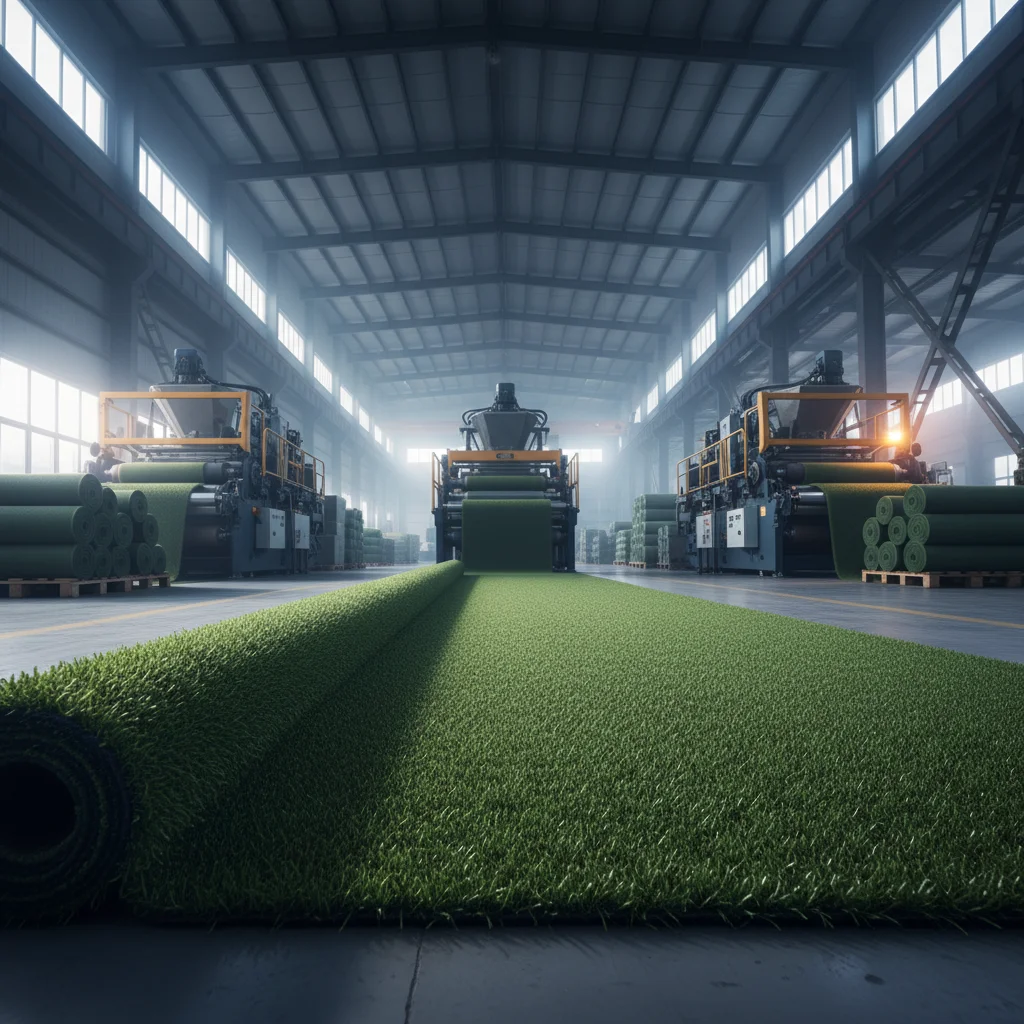
HEBEI XIONGYI RUBBER & PLASTIC PRODUCTS CO., LTD. ("XY Grass") operates a vertically integrated manufacturing facility covering 5000 m². This control over the production process, from raw polymer to finished roll, translates into specific advantages for bulk buyers.
OEM/ODM Design & Customization Capability
Beyond standard green, we support the creation of brand-specific athletic fields. This includes:
- Custom Field Layouts: Integrating team logos, midfield emblems, and boundary lines directly into the turf during manufacturing.
- Specialty Color Development: Matching school colors, corporate branding, or unique design concepts with technical consultation on color performance.
- Performance Tailoring: Adjusting fiber composition, pile height, and infill recommendations based on climate (extreme heat/cold) and usage level (professional, collegiate, community).
Quality Assurance & Compliance Framework
Trust is built on verifiable standards. Our production adheres to:
- ISO 9001:2015: For quality management systems.
- Material Safety: Testing for heavy metals (lead, cadmium) and other substances to meet global standards. Our turf is RoHS compliant.
- Performance Testing: We can provide third-party test reports for key metrics: shock absorption (ASTM F1936), vertical deformation, and head injury criteria (HIC).
Note: Specific certification copies and test reports are available upon request and are subject to the latest testing dates and standards.
High-Speed Delivery Powered by China's Supply Chain
Our location within a major industrial hub optimizes logistics:
- Production Lead Time: Standard products: 15-20 days after deposit confirmation. Custom/OEM projects: 25-35 days, depending on complexity.
- Packaging: Turf is rolled onto sturdy plastic cores, wrapped in plastic film, and secured on wooden pallets for ocean freight.
- Logistics Support: We handle FOB terms efficiently and can assist with CIF arrangements. Our experience ensures proper container loading to maximize space and minimize shipping costs per square meter.
MOQ: Typically one 40ft HQ container (approx. 700-800 sqm, depending on roll dimensions). Sample rolls are available for evaluation prior to bulk order.
Trust Endorsement: Insights from Real Projects
Here is feedback from professionals who have sourced and installed our colored turf systems.
Mark T., Sports Facility Manager (Florida, USA): "We needed a true orange and blue field for our university's intramural complex. The color matching was precise, and three years in, the fade is minimal even under the Florida sun. The consistency between shipments allowed for seamless installation across multiple phases."

Sarah L., Procurement Agent for a Branding Firm (UK/Europe): "Our client wanted a bold, non-traditional colored pitch for a flagship retail sports park. XY Grass worked through multiple design iterations and provided full technical data packs for local planning approval. Their OEM process made a complex design executable."
David K., Installation Contractor (Texas, USA): "I've laid turf from many suppliers. The backing on this product is consistently strong—it cuts cleanly and sews well. The rolls arrive clearly labeled and undamaged, which is half the battle on a tight schedule."
James P., Director of a Youth Sports Non-Profit (California, USA): "Budget was critical. We compared 5 suppliers. XY Grass offered the clearest breakdown of specs versus cost. Their product met the critical ASTM safety specs we required, allowing us to allocate more budget to a high-quality infill system."
Clear Next Steps for Your Procurement Process
Evaluating a supplier for a colored turf football field project requires a structured approach. We recommend the following:
- Request a Physical Sample Kit: Evaluate fiber texture, color, and backing strength firsthand.
- Provide Your Specifications: Share your project layout, desired colors (Pantone codes), performance requirements, and target certifications.
- Ask for a Detailed Quotation (Proforma Invoice): This should clearly state product code, technical specs, total sqm, unit price (CBM or sqm), FOB/CIF terms, payment terms (typically 30% T/T deposit, 70% before shipment), lead time, and port of loading.
- Verify Compliance Documentation: Request relevant test reports and certification documents for your review.
- Schedule a Virtual Factory Tour: See the production and quality control processes in real-time.
Ready to move forward with a technical discussion for your colored football field project?
Contact our project specialists:
📞 Tell: +86-13931845866
✉️ Email: sales@xiongyigrass.com
🌐 Contact Page: https://www.xy-grass.com/contactus/
📍 Add: Hope New District, Mengcun County, Cangzhou City, Hebei Province, China
FAQ: Colored Turf Football Fields
How long does the color last on colored football turf?
Premium colored turf with integrated UV stabilizers can maintain vibrancy for 5-8 years before noticeable fading occurs, depending on local UV index and usage. Technical data sheets provide specific lab-test UV resistance ratings.
Can you install colored turf in very hot or cold climates?
Yes, but the material specification matters. High-density polyethylene (HDPE) fibers offer excellent UV and heat resistance. The infill system (e.g., elastic layer) may be adjusted in colder climates to maintain performance and prevent hardening.
What is the typical lead time for a custom-colored field?
From final design and color approval, production for a full container load of custom-colored turf typically takes 25-35 days. This includes masterbatch creation, production, and quality control. Shipping time must be added based on destination port.
Are there extra costs for OEM/ODM designs like logos?
Yes, custom designs involve setup costs for digital tufting patterns and potential yarn changes. These are one-time fees amortized over the project. A detailed quote will separate tooling/NRE (Non-Recurring Engineering) costs from the per-square-meter product cost.
What safety certifications should I look for?
For North America, ASTM standards (e.g., F1936 for shock absorption) are key. In Europe, look for EN standards. FIFA Quality Pro/Quality is a recognized international benchmark for high-level play. Always request recent test reports from an independent lab.
Disclaimer: All specifications, lead times, and performance data are for reference based on standard production. Final product specifications and terms will be detailed in the official sales contract and order confirmation.
Suggested Image Alt Text for Your Project
- custom-colored-football-field-school-logo-midfield
- blue-red-artificial-turf-sports-field-aerial-view
- durability-test-colored-synthetic-grass-fibers
- turf-roll-packaging-warehouse-shipping-ready
- OEM-color-match-pantone-chart-artificial-turf
About the Author:  Jordan Mitchell is a synthetic turf systems consultant with over 12 years of experience in specification, procurement, and performance analysis for institutional and commercial sports projects across North America and Europe. He focuses on translating technical manufacturing data into practical project and procurement insights for facility managers and buyers.